

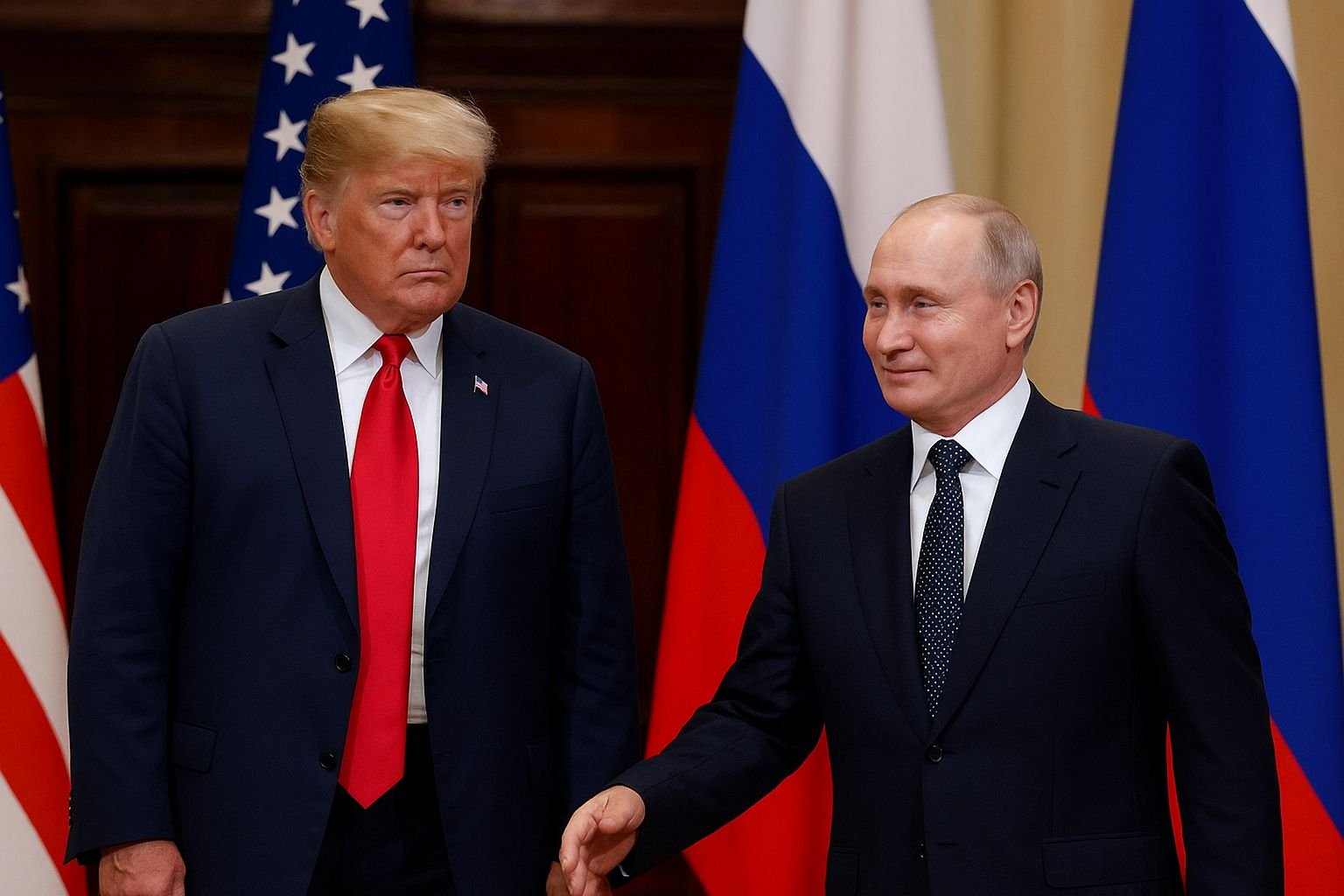
Alaska — August 16, 2025 — President Donald Trump and Russian President Vladimir Putin ended their high-stakes summit in Alaska today with warm words but no breakthrough on Ukraine. While the two leaders praised the talks as constructive, Trump urged Ukrainian President Volodymyr Zelensky to strike a deal with Russia, and Putin extended an invitation for their next meeting to take place in Moscow.
Trump Praises Putin, Pushes for a Deal
Speaking after the talks, Trump described Putin as a “strong guy” and said their private discussion was a “very warm meeting.” He used the moment to call on Zelensky to negotiate directly with Moscow, arguing that both Russia and Ukraine had suffered heavy losses.
“It’s a terrible war. Ukraine is losing a lot, Russia is losing a lot. Hopefully it can get completed, which can be an achievement for them. It’s up to President Zelensky to get it done,” Trump said.
Trump emphasized that any ceasefire or peace deal would require Kyiv’s consent. “It’s not a done deal at all, and Ukraine has to agree. President Zelensky has to agree. I think we are pretty close to a deal, but Ukraine may not agree to a ceasefire,” he told reporters.
He also linked Ukraine’s hesitation to Western financial support. “Biden handed out money like it was candy. We gave Ukraine $350 billion. Europe gave him much less, but still a lot — about $100 billion,” Trump claimed. “Maybe they’ll say no because of all that money, but the war has to end.”
Putin: “Very Good Conversation”
Putin struck a conciliatory tone, saying he appreciated the atmosphere Trump created during the Alaska talks. “We had a very good conversation with President Trump today. Thank you for creating such an atmosphere here,” Putin said during a visit to the graves of Soviet World War II pilots in Anchorage.
In a remark that signaled eagerness for further talks, Putin added: “Next time, let’s meet in Moscow.”
Kremlin Envoy: Talks “Productive”
Kirill Dmitriev, a Kremlin envoy who attended the meeting, described the Trump-Putin Alaska summit as “definitely productive.” He said the two leaders covered a wide range of issues, including potential U.S.-Russia economic cooperation.
Dmitriev emphasized that while no formal agreements were signed, the tone of the meeting signaled a willingness to keep channels open. “A lot of issues were discussed. President Trump also outlined possible areas of economic partnership. That in itself is progress,” he said.
Symbolism and Side Meetings
The day was heavy with symbolism. After their closed-door talks, Putin paid his respects at the graves of Soviet World War II pilots buried in Alaska. Later, he met with Orthodox Archbishop Alexei of Sitka and presented him with an icon of St. Herman of Alaska, the Orthodox patron saint of the United States.
The cultural gestures, Kremlin officials said, were designed to highlight “shared history” and to soften the image of the Russian president abroad.
Zelensky Expected at the White House
While Trump pressed publicly for Zelensky to “make a deal,” attention is already turning to Washington. The Ukrainian president is expected to meet Trump at the White House on Monday, according to U.S. officials. That meeting could prove decisive in testing whether Zelensky is open to Trump’s push for direct negotiations with Russia, or whether Kyiv will resist pressure to compromise.
You might also like:


For Trump, the back-to-back meetings underscore his central role in shaping the direction of the war — first face-to-face with Putin in Alaska, then with Zelensky in Washington.
A Meeting Watched Worldwide
The Trump-Putin meeting in Alaska attracted global scrutiny, with governments across Europe and Asia closely watching for any sign of progress on a potential Ukraine peace deal.
Trump insisted that the summit should not be judged solely by the absence of an immediate ceasefire. “There’s no deal until there’s a deal, but we made progress,” he said, rating the talks a “10 out of 10.”
Putin, while careful not to disclose details, seemed eager to frame the meeting as a success in tone if not substance. His invitation to continue talks in Moscow underscored Russia’s desire to keep Trump engaged on its terms.
Reactions From Allies
In Kyiv, Ukrainian officials reacted cautiously, stressing that any agreement must respect Ukraine’s sovereignty and borders. European leaders, meanwhile, reaffirmed their position that Russia should not have a veto over Ukraine’s membership in NATO or the European Union.
Analysts noted that while the Alaska summit may not have delivered a breakthrough, it set the stage for more negotiations. The optics of Putin standing alongside Trump in U.S. territory, followed by an invitation to Moscow, signaled a shift in tone that could shape the months ahead.
What Comes Next
For now, no ceasefire has been reached, and no timeline has been announced for further talks. But with Putin calling for a next round in Moscow, and Zelensky preparing to meet Trump in Washington on Monday, the diplomatic spotlight is firmly fixed on whether Ukraine will engage — or resist.
As the war grinds on, the Trump-Putin Alaska meeting may be remembered less for what was agreed upon and more for what it set in motion: a series of conversations that could determine the outcome of Europe’s bloodiest conflict in decades.
FAQ
Q1: What did Trump and Putin discuss during their Alaska meeting?
Trump and Putin spoke for about three hours in Alaska, focusing heavily on the war in Ukraine. Trump praised Putin as a “strong guy” and urged Ukrainian President Volodymyr Zelensky to “make a deal” with Russia to end the conflict. Both leaders also touched on possible U.S.-Russia economic cooperation, according to Kremlin envoy Kirill Dmitriev.
Q2: Will President Zelensky meet Trump after the Alaska summit?
Yes. Ukrainian President Volodymyr Zelensky is expected at the White House on Monday for talks with Trump. That meeting will be closely watched to see if Zelensky is open to Trump’s push for negotiations with Russia or if Kyiv continues to reject concessions.